Inca Trail: Day 1 of 4
My mother and I started out our journey in old school bus picking up the five other members who we would be hiking the Inca Trail with. I wasn’t aware that this was going to be more of an arranged 4-day marriage with forced physical exertion. We were riding with 3 very pretty Canadians two twins and one of their fiancés. For the life of me, I could not tell them apart except for the fact that one of them would repeatedly flash her brand-new ring around when anyone would mention marriage, wedding, matrimony, babies, or anything that rhymes with either one of those words. My mother and I immediately rolled our eyes at their conversations. The twins and their petite frames loved doing yoga, running marathons, and Starbucks. Each year they would take one adventure vacation, and they would take enough pictures on that vacation to fill up their Facebook profile pictures for the following year. The Canadians both had long, smooth black hair, and the latest hiking gear. The two girls became extremely offended when I told them I thought it was cute the way they all said “aboot.” They said that was a common misconception about Canadians. Despite the fact they just had said they don’t say “aboot” they let out a hearty “aboot” about every three minutes for the remainder of the trip. Our second couple was a completely adorable English woman and an attractive Australian that made all other couples look like Roseanne and Tom Arnold. These two lovebirds both got let go from their jobs in the UK and instead of trying to find another one right away they took their severance packages and began traveling the world. They had such a good education on their shoulders that they began blogging about their experiences. This part-time blogging got them enough of a following to fuel their journey for quite a bit longer than they expected and they never looked back. They instantly became, and are still today, my personal heroes. This little group of people, plus my mother, just became my family for the next 4 days, whether I liked it or not.
Our bus ride took us through the outskirts of Cusco and down into the Sacred Valley where the people were still living off of the land. We passed a marketplace where there was a multitude of fresh vegetables and fruits. There was a special section of the market that sold large bundles of grass. Our tour guide asked us what we thought those bundles were for. We all guessed bedding or fire fuel. Instead, he told us it was for their “pet” guinea pigs. He said most Peruvians have 30-40 guinea pigs living in their walls at any given time. Whenever there is a special occasion they will pull them out of the walls and have them for dinner. The first sign of becoming a man when our guide Paul was growing up, was catching, killing, and cleaning a guinea pig. The bus ride swept us in and out of the mountains until we reached our destination: The start of the Inca Trail. The entire Inca Trail runs from Bolivia, through Peru, and into Columbia. However, the four days we were hiking were considered the most sacred because they ended at Machu Picchu.
We began our hike across a long swinging bridge across a river. The path was a little hilly but primarily flat. I got a little arrogant at the thought that I thought this was going to be a difficult hike for me. As we admired the desert plants around us, our guide Paul began explaining what each one could be used for. We first started with the Agave plant. I, of course, said “tequila!”  Paul then told that the juice could be used as an antiseptic, the needles, and long strings that come off of the leaf which could also be used to suture deep wounds back together. While most of us would simply nod in understanding my mother would loudly gasp with, “Oh really? Wow! I had no idea!” She had a way of getting so excited about new information it almost came across as fake and insincere. I would sometimes have to explain to others, “No, she is just really excited about information,” when they would give her an odd look. As far as I was concerned about my whole life, she was just a person who was extremely enthusiastic about facts. Paul went on to tell us there was a white flower that could be boiled with a pink flower for natural abortions that apparently had no harmful effects on the mother. My mother exclaimed “that’s a shame!” at the sound of the word abortion. Paul then told us about a blue flower that if boiled would make a person temporarily paralyzed and feel no pain. They would use this flower if they were doing surgeries. Paul rattled off facts about everything living and non-living thing that was around us with ease and we were all hanging on his every word while my mother continued to shriek in exasperated delight and horror. Just as I was feeling lucky to have such a great tour guide, Paul reached for the nearest log and tipped it over.
 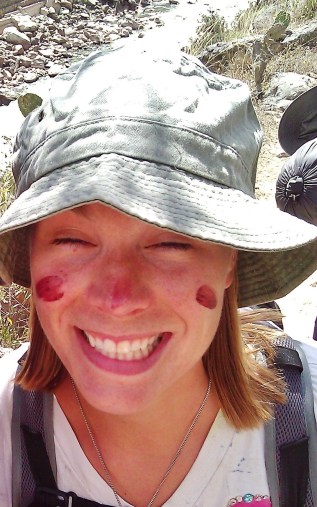 Thousands of tiny bright red bugs fled the light as Paul grabbed them as fast as he could. He gave each one of us a bug and told us to crush it up in our hands. Paul showed us how to crush the bug our palms and a wide variety of bright reds and purples smeared across his hand. Paul gave each of us a bug and instructed us to also smear the bug juice across the top of our cheek. He told us the natives could make up to 60 different colors to dye fabric using these little bugs. The group looked at the insects in mild disgust while my mother couldn’t have smashed them into her cheek faster. She knew she wasn’t going to be the best hiker, but goddammit, she was going to be the best student. Paul jokingly called us Inca football players and we carried on our hike.
Our group eventually got to our first set of ruins. Paul talked about how this is probably one of the first sites Hiram Bingham saw in 1911 when he “discovered” Peru. Paul reminded us that Hiram Bingham discovered the Inca civilization much like Columbus discovered America. Other generations of people had known about it for thousands of years, they just weren’t white Europeans. The road continued and was described as Inca Flat. This just meant that the hills were rolling with no steep climbs or descents. This was the easiest day so we were cruising along quite nicely. Each one of my mother’s steps was painfully deliberate, even in this easy terrain. My mother hiked as if she felt that each step was going to lead to her inevitable death. She would stop each foot in the air before carefully choosing where to place it. Despite her best efforts my mother slipped and slammed her elbow into the ground. She got up and put on a strong face while a baseball-sized welt slowly continued growing in her elbow. This day was supposed to be easy and safe compared to the rest. By the end of the following day, we would be 14,000 ft high above the clouds on narrow trails with steep drops. Multiple people had died on this hike by simply just falling off the trail. I was concerned about my mother.
We were nearing lunch time and I was getting a little hungry. I was looking forward to whatever peanut butter and jelly sandwiches with chips I assumed they had waiting for us. Maybe if we were lucky we would get a Pepsi too I thought with my mouth watering. As we came upon our lunch site I couldn’t believe what I saw. Two large tents were set up. One tent was for cooking and already had large billowing puffs of smoke coming out from the top wafting delicious smells that competed with the tents around it.


Another tent was for eating, complete with tables and chairs. The first dish that was brought out to us was guacamole and chips. I used to love guacamole until a couple of years prior when I had a bad experience with some Aldi’s guacamole and was sick for four days. I had not been able to make eye contact with an avocado since. Apparently, Peru is known for their avocados, making their guacamole the best in the world. I succumbed to peer pressure and went ahead and took a heaping spoonful. The sickening smooth and chunky feeling quickly consumed my salivating mouth as I tried to appreciate the freshly picked avocados and cilantro. Since I took such a large scoop I was going to have to find a way to eat this massive green pile and save face while remaining appreciative. Paul our guide said the best way to eat an avocado was to sprinkle some salt on it and take a sip of strong coffee. I did not want to acquire an aversion to the taste of coffee as well so I passed on that opportunity. After our appetizer came our meal. We had fish, quinoa soup, and rice. My mother leaned over to me and whispered, “your father would have hated this meal” and chuckled to herself while she went on to gobble down the soup. She was right. My father would have sooner starved than put quinoa or vegetables in his mouth. But to my mother and I, it was far more delicious than we ever could have anticipated. I couldn’t believe how lucky we were to be sitting up high in the mountains eating like queens. Still today I have no idea how those Peruvian men kept, eggs, fish, and cheese fresh in those packs of theirs, but I never doubted the quality of their food for one minute. We hung out in the tent for a little while longer talking and getting to know one another. Paul taught us how they made cocaine (generally made in Peru and exported to Columbia). He said that the people that actually make the cocaine are old men way up in the highlands who have a week or more of time on their hands and want to make a little extra cash. It doesn’t start out as some big sneaky and illegal operation but it certainly turns into one. They acquire millions upon millions of coca leaves. The coca leaf was a leaf that we had been chewing on and drinking the tea form of, for about a week with no alarming effects at all. It tasted like green tea, was refreshing, and only felt mildly caffeinated. Paul told us these men dump the millions of coca leaves into a pool-like area and cover it with kerosene. After it is properly stirred they mix in a large quantity of malic acid and continue stirring. During each step, my mother let out an overly surprised “gasp!”
Kerosene “Gasp.”
Malic Acid “Gasp.”
Large pool “Gasp.”
“Not every fact can be shocking mom” I whispered at her annoyed while she purposefully ignored me. At the end of the complicated process, the only thing left is afoot by foot cube of cocaine. Inside of the cube is the densest and purest form which sells for the most money. After the cocaine is distributed, diluted, and sold the net worth of the cube is worth millions of dollars. However, the Highlander men only sell them for around a thousand a piece.
After lunch, and informative adventure in the retail vs. market value of cocaine, we continued our walk. I was groggy after all of the food and it was hard for me to stay as quick-footed as I was before. As our walk progressed I began feeling very sick. I tried to shake it off but the feeling just got worse. I stopped to take a break but that seemed to have no effect on the angry bomb that was trying to blow its way out of my body. I told myself: My choices are, to throw up or keep going. If you can’t keep going, you need to throw up. I stopped trying to find a nice place to sit away from people in order to regain my composure and instead I let the vomiting process occur naturally. I focused all of my attention on puking. I imagined guacamole, mountains of it, heaping onto my plate and into my mouth, gulping down spoonful after spoonful. Sure enough, within seconds, I was on all fours hurling into the bushes off of the side of a cliff. Normally being so close to the edge of a cliff would terrify me, but with watery eyes and a nose full of guacamole and fish, I didn’t seem to care as much. I gripped the plants that were also clinging to a cliff with all of my might and continued hurling into the abyss. People walked by and either saw, heard, or smelled me. Most ignored the situation altogether, and one porter consoled me with a soft “Amiiigaaaaa.” After I was done, I stood up and continued walking. I heard about how bad it was to vomit on trails so high in the mountains because your body needs so much more nutrients and water than normal. However, I could not stop thinking about how skinny I’d be by the end of the trip if I kept this up.
After a couple of hours, we had gotten to our campsite. Our tents and sleeping pads had already been set up and the cooks were working away making us dinner. My mother and I laid down immediately and changed into our other footwear. It was beginning to get quite cold out and the Canadians were frantically trying to complete their yoga routine before it got dark. We began dinner with some popcorn and chips talking about the day’s hike. We had some chicken and rice soup and a blue corn dessert that smelled like cinnamon Christmas. Our group stayed up a little bit drinking cocoa and then we headed straight for bed. Tomorrow was supposed to be the toughest day.
Inca Trail Day 2
At 4AM the next morning we woke to a porter knocking on our tent door and loudly exclaiming “coca tea!” I wiggled out of my sleeping bag cocoon (it was around 40 F outside), opened the tent, and grabbed the tea. Normally this is the part of my day where I would convince myself it was a good idea to stay in bed. However, I found convincing myself to lie back down was a very hard thing to do with boiling tea in my hand. I had to stay sat up and slowly wake up. I have never gotten used to waking up early. Even when I swam on the swim team throughout high school and college I woke up every day at 5:30AM. And every day I hated it more than the day before. Even after jumping in the freezing cold water I still remember closing my heavy eyes for far too long and crashing into the lane line while trying to slip in some rest during warm-ups. My mother naturally had an obnoxiously positive attitude toward morning. She said gruesome things like:
“Up and At em’”
“The Day is new!”
“Well, it’s morning so we had better get going! get going! get going! get going!”
During these early mornings, I had to remind myself why on earth I came in the first place. Lucky for me, since my mother was the weak link she had already left to go hiking for the day and had left out of the tent relatively quietly.
After my tea, I took a swipe-down shower with a baby wipe and got dressed for today’s hike. I headed down to use the restroom and, on my way, down I saw rooster, a donkey, a cat, a puppy, and a guinea pig in the living room of the home. All animals and humans were awake and ready to start the day with energetic chatter. I tried to use their energy to start my day as I walked to use the toilet. Unfortunately, I did not realize that it was going to be the last toilet of my trip. Granted I am an anomaly and I love using the restroom in nature. In fact, when I am home, I generally read National Geographic’s on the toilet to prepare myself for different restroom scenarios my mother might get me into. However, the South American toilets that I would be using for the next 3 days were not quite as nice or forgiving as nature.
We began our day with a 3-course breakfast. Bread, jam, pancakes, and an omelet. My mother had grabbed breakfast much earlier and had left with a guide. Paul was afraid she wasn’t going to make the days hike in an appropriate amount of time so he sent her on her way early. For the first time since I was a little kid after dropping me off for my first day of college, I missed my mommy. We got hiking around 6AM and I felt the pressure and pain in my chest immediately. Not only did I feel physical discomfort, but my ego took a blow as well. I felt as though I was breathing louder than anyone. I felt like an English Bulldog who was asked to run a marathon. Everyone else seemed to take on the straight up climb with ease and normal breathing, while I felt like I was the only one in the entire group who found this difficult. I couldn’t help but think if I had said no to this trip I could have just taken a week off from work and I would be sleeping right now. I’d wake up late, make eggs and coffee, and have a splendid day of nothingness. However, the familiar pressure in my chest and the pain in my legs reminded me that this was not reality.
The day was crisp and cool and we hiked past many Peruvian families who were just beginning their daily chores. My favorite part about their culture was that while they would sometimes wave and say hello in Quechua, there was never a time where they were trying to sell us things no one needs that they may or may not have actually made themselves. It was contradicting to compare the real Peruvians living in the mountains to the ones selling trinkets on the street and dancing on the islands who would aggressively come up to you and try and sell you things. In fact, the only similarities between the two were the women’s brightly colored scarves that they either wore around them as a shawl to keep warm or would even use them to lift heavy items because they were made of such strong alpaca fibers. The Peruvians up here were just living their lives and working which was delightful to see. Their normal daily attire consisted of sweatshirt/sweatpants and a pair of old Chuck Taylors or homemade sandals which they used to float effortlessly up and down the uneven stones that made up the trail. These people made, what was impossible for me, the daily routine for them. The first week of our trip we had assumed the Peruvian culture was selling trinkets on the street or dancing with their scarves high in the air. However, up here in 7,000 ft elevation I finally got to see it for myself.
We hiked what seemed like straight up the mountain for about an hour. Each stone had been masterfully placed by the Incas almost 2,000 years ago. Each step was about 2 ft tall and had a smooth indentation in the center from the 500 people that walked it each day. I felt like a fish out of the water as I slowly inched my way toward the top of the mountain. Since these were switchbacks I only had to focus on a 25-meter section at a time. This would allow me to trick my brain into thinking the hike was over at the next turn. Then I would reach the turn, look up, and see an entirely new set of steps. This day was endless and it had only been a couple hours. My mother had been hiking for three hours at this point and was nowhere in sight. We finally came up to a clearing where the porters were getting our morning snacks ready. Coca tea, popcorn, and crackers were all displayed on a table overlooking the mountains.
Being a girl from Iowa I had no real idea of just how big the Andes Mountains were. These mountains made Colorado and John Denver look like a chump. Pictures, including the ones I had taken, consistently dwarfed the mountains and never did them any real justice. It was one agonizing step after another to hike up them, and although each step brought us closer to our destination it also brought us closer to less oxygen. Every 15 minutes or so I didn’t think it would be possible for it to get harder to breathe, but I would be wrong every time.
I was relieved to see my mother at our resting point and we were all able to sit down and look out on everything we had just climbed up. Probably the best thing about hiking is the results of your hard effort are almost immediate. I put my head down for a couple hours and do my best and I get to look down at how far I had come. I hope my mother felt that way too. It had only been a year since their divorce was official and I’m not sure which was worse: the pain she felt with my father walking out on her, or the stigma she felt from getting divorced while being a Catholic in a small town in Iowa. My mother wasn’t technically Catholic but she was raised Catholic which is almost the same thing. There is a saying that goes, “once a Marine always a Marine” I think that line was probably stolen from a Catholic. My mother had passed down her Catholic guilt to us kids at a young age as well. Even though I didn’t even believe in a God I still felt the thick presence of Catholic guilt with every impure thought. The best part about Catholic guilt is even if you don’t feel it yourself if you come from a small town everyone else’s judgment of your lack of Catholic guilt will hurt you just as badly. Even if my mother did not feel accomplished after our 4-day hike, I was hoping she at least would feel better getting away from our “Divorce is sin” town for a little while.
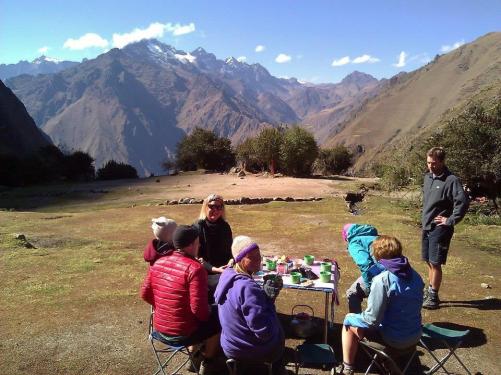
Our group kept moving our table to follow the sun and Paul referred to us as “big guinea pigs.” Once we stopped hiking it was easy to get cold. Nights got down to 35 degrees and since we began hiking at the end of the night if we weren’t moving we were probably freezing. We picked up our packs and my legs were already aching considerably. My mother started the climb with us but soon fell behind. Our guide Paul started talking to my mother about everything around her. She was constantly gasping for air but would use what little she had to gasp out questions about the Incas. My mother read travel books about the Incas for fun. There was no way she was going to miss this opportunity to talk to a professional tour guide who grew up immersed in this culture just because she simply didn’t have enough oxygen in her body. She may not have been the most physically fit or youngest on the trail, but she was the most informed about the area.
As my mother hiked, slowly, and deliberately up the large steps Paul took them slowly with her. Looking back watching Paul walking at the same pace as my mother while he chattered on about all of the geologists, naturalists, and spiritual leaders that came through the area who taught Paul, even more, made me happy. This situation made every turn in the switchbacks for my mother like turning the page of a book. Every new thing Paul saw on the trail could remind him of a new story and my mother was eating it up. Paul was obviously not out of breath at all and was able to use all of his air acting as a personal tour guide for my mother. He never showed any signs of becoming annoyed at telling the same story over and over. After 4 days he would get a whole new set of curious people, each of different physical abilities, and he would need to repeat the same stories over again. I can only imagine doing this day in and day out would be exhausting. But Paul acted as if we were the first and last group he was ever going to have. He acted as if he had been dying to tell someone these stories for years and finally someone would listen to him. And he acted as if he really cared about us. Seeing him so patient with my mother and her enjoying herself so much was something I was not used to seeing. Because as chance would have it my father’s name was Paul. And as chance would have it, Paul was the Americanized name our Peruvian guide had chosen for himself.
My parents had obviously despised one another growing up. Seeing them pretend to be happy in public was almost worse than hearing them fight at home. That is if they actually cared enough to argue at all. Usually, my dad would get home from work, sit down in front of the food my mother made, (in general it was very healthy and probably contained lentils and/or tofu). He would take one bite, tell my mother it tasted like shit, make himself a bowl of cereal, and go down in the basement to watch television. I did not know from an early age that this was not an appropriate way for a husband to treat his wife. All I knew is that marriage was something I wanted nothing to do with. This is perhaps why I had run from it my entire life. Mike, my own boyfriend of 5-years had wanted to marry me, and I could not find one ounce of excitement for the prospect of marriage. I had never met one couple whom I thought was better off after being married. It sounded to me like a fast track into becoming the worst version of myself that I dreaded becoming. But then there was a man who named himself Paul on purpose. He was slowing himself down to be with my mother, did not feel the need to tell her how much she was slowing him down or how much faster he could be going without her, and seeming to enjoy it all the while. Too bad we had to go all the way to Peru to find exactly what my mother needed.
All of a sudden, the switchbacking in the forest stopped and the trail continued for what seemed like straight up for at least a mile. We were almost 14,000 feet up in the sky. I trudged on step by step. No one around me was excited, only exhausted. My small pack was dwarfed by the porters who passed me with theirs. I constantly felt like a shitty American getting passed by all of these hard-working natives.

Paul insisted that I should not feel this way because they were paid very well and their families were going to be able to live off of the money they made during this 4-day period for a long time. I still felt as though I should be doing carrying more in my pack to help out. I continued climbing to the top until I finally reached the summit. People were high fiving me who I didn’t even know and everyone was celebrating with pictures and some even with tiny flasks of booze. I turned around as my favorite porter was coming up the summit and I gave him a high five as well. He seemed just as relieved and happy as the rest of us that he had made it so far up the mountain. Paul told us that the Peruvians in the Sacred Valley worked very hard all day. He also told us their quality of life was outstanding due to the nutrient dense food they grew and ate and sense of community they extended out to one another. Paul told us laziness was considered a mental illness. If someone in a community would start to become lazy and tired the community would surround him/her, pray for them, and offer them support. Hard work was embraced and respected in Peru and was linked with their religious spirituality. And still, after hearing all of these beautiful things, all I wanted was a cold beer, some pizza, and a nap.
After enough photos had been taken at the top of “Dead Woman’s Pass.” Which was named by the way the mountains looked from afar (One big mountain boob with a small mountain range to the left that vaguely resembled a face). My mother took “Dead Woman’s Pass” as a personal slight against her and took it as a sign to make sure she was even more careful than normal by climbing up the steps even slower. The trail, of course, took us to the top of the “Dead Woman’s” breast and on the way down that was all anyone could talk about. We had officially finished the hardest and slowest part of the Inca Trail by reaching its highest summit. And even though my legs were on fire, the following day would pale in comparison.
We took lots of pictures at the summit and Paul had even packed some rum with small shot glasses for us to celebrate. After our Canadians had officially taken enough pictures we started the hike down to our campsite together. We descended down our 14,000 ft. elevation for a couple of miles until we finally reached the campsite. Each of our tents was properly placed overlooking a large valley. We each got a cup of tea while we hung out in our tent above the clouds watching the storm come in above the valley. Smoke billowed out of the cooking tent while our quinoa soup and fish were being prepared.
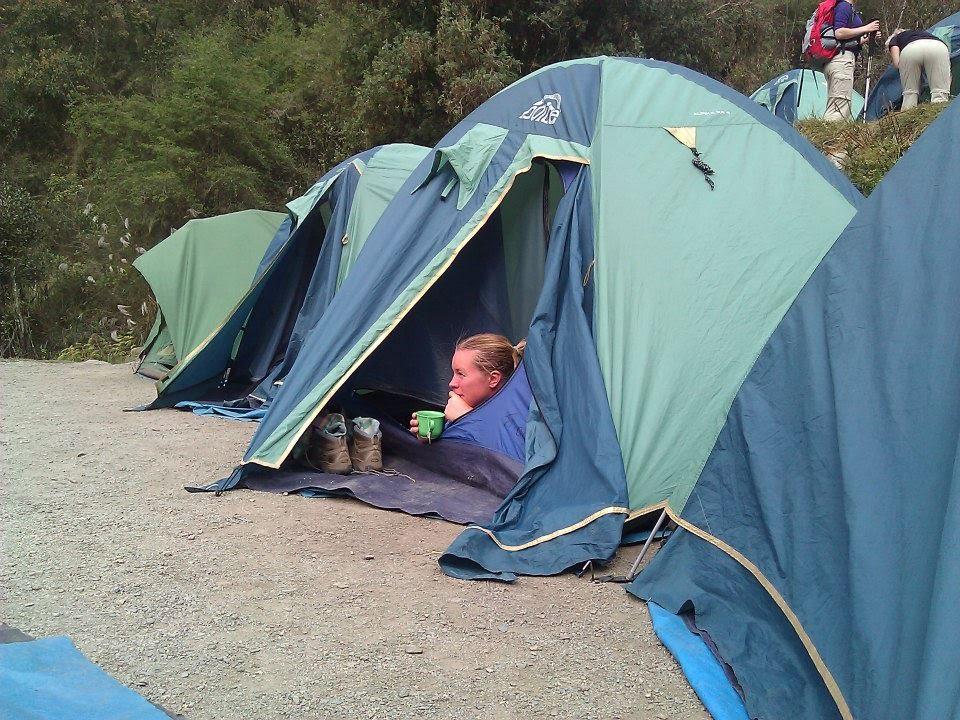
While getting ready for bed my mother briefly removed her pants. A large rash was spreading all over her legs. My mother, to save room in her pack, wore the same pair of black jeans all 4 days of her trip. She did not take them off in her sleeping bag because she needed all of the warmth she could get. This prolonged exposure to tight jean material did not make her legs happy. “This rash is the least of my worries,” my mother reminded me as she pulled her pants back up before zipping up her cocoon sleeping bag all the way around her head. She fell asleep immediately while I focused on all of the discomforts of my body. All throughout the night, I would wake up with a cramp screaming through my thighs and butt, unzip from myself from my sleeping bag, and stretch it out. Go back to sleep, wake up with my body screaming, stretch out my cramp, go back to bed while my 60+ mother was sleeping next to me soundly as a kitten.
Inca Trail Hike-Day 3 of 4:
Sleeping in the clouds is something I remember wanting to do as a child. I would look up at the clouds that were 1,000 feet above my head and desperately wanted to reach up and touch, run, and float around inside of them. As it turns out, clouds simply look like fog when you are inside of them. Another childhood dream dashed to reality. Yesterday’s hike was hard but it would be nothing compared to day three. Most people in our group were excited about today. Today was going to be the easiest day for everyone but my mother and me. Because today was the day we were going to go down the mountain.
Our six-foot-tall, 180-pound, curvaceous, and weak-kneed bodies were supposed to go down the mountain we just climbed up. Our bodies were the polar opposites of the Peruvians around us. Peruvians were short, sure-footed, small hipped, and had large strong joints. In addition, while we showboated around in our brand-new Merrell boots, Peruvians flew up and down the trails in crummy homemade sandals. As a collegiate athlete, I have never had a problem fighting through pain, endurance, tired muscles, or laborious activities. However, I have the balance of a toddler and the knees of an obese 70-year-old man. 
Going down those sturdy but uneven ancient steps, one foot or less away from the cliff’s drop-off had my mother and I terrified. I wanted to talk to her at breakfast about it but as usual, she had already taken off an hour earlier than the rest of us with a porter. She did this in order to make it back to the campsite before dark. There had already been enough deaths on the Inca Trail without people staying out there late at night.
Paul had informed us he had been doing Inca tours for years now and did not even have an apartment or a home to go to because he spent all of his time giving tours during all 4 seasons. He did tell us that he spent a couple weeks going home for Christmas each year. I think about him often while working at my day job and often question which life I would prefer. I love imagining him lazily dragging along his hiking stick giving his tourists doses of information about every plant, shrub, and view in his sight. Switching effortlessly back and forth between Quechuan (which the porters spoke), English (which most of the tourists spoke), and whichever of the other 3 subsequent languages he knew. I can hear him whining about getting chubby because it wasn’t a hard-enough hike for him and the food was always too good for him to pass up. And of course, one of Paul’s all-time favorite things to do, which was giving us little quips and stories about each section of the trail. Unfortunately, his stories often included who fell off the mountain, what country they were from, where they slipped, and how long it took them to recover their body.
After a healthy dose of quinoa pancakes and cheddar cheese omelets, we started our hike. The other 5 members of our group took off with optimistic confidence while I left with thoughts of my knees giving out and my body falling into the abyss. “How long did Paul say it took them to find the Italian who went missing?” I asked myself. “Oh right, it was two weeks until vultures were seen flying above the spot where his body laid to rest.” A week later a helicopter came and got him. I’ve lived a pretty good life I guess,” I reminded myself trudging on. I often took my mind off worrying about myself by worrying about my mother instead.
Our group finally reached the very peak of the mountain so we could begin the descent. From our position, the view of the descent was vertiginous. The angle of the steps created a feeling of anxiety as each footfall landed on an unlevel stone, pushing us involuntarily forward; downward went each step with slight switch-backing to make it “easier.” To make things even more difficult, the Canadians had to stop every 60 seconds to apply sunscreen, switch out their sunglasses (the sun had yet to come up), get a protein source (we just had breakfast), or reach for their camera and take yet another selfie. Well after everyone had gone on ahead I still waited until they were out of view, and then I did something that I still consider today the smartest thing I had ever done: I packed up my hiking pole and sat down. I put my feet in front of me, my sturdy swimmer arms under me and began crab walking down the mountain. I knew it wasn’t going to be long until a porter gained on me, so I made it a habit to turn around frequently. My knees had never felt better and my triceps were getting a great workout too. I basked in my brilliance as I inched my way down the mountain like a large child. Every time I would hear the familiar steps of a porter effortlessly flying down the mountain, I would stand up, smile at them while they passed, and then I would sit back down and continue crab walking. Considering there were about 3 porters for each hiker, I was stopping quite often. After about an hour I hit a flat point I decided to go back to my bipedal ways and eventually met up with my group at the checkpoint.
“I really thought your mother was going to be here,” Paul said.
I agreed with a pretend and anxious smile as I began thinking of my mother as another statistic Paul would tell his hiking crews about.
“How old is your mother?” Paul asked in more of a serious tone.
“Sixty!” I replied with enthusiasm thinking he was going to tell me what a great job she was doing for her age.
“She’s the second oldest person I have had do this trail,” he said.
“The oldest was 70 and he was a former marine,” Paul added.
Everyone began talking about how impressed they were that my mother wanted to come with me on my adventure. I corrected them and told them that I came on her adventure. A few hours later and I found my mother waiting for me in the tent sipping coca tea. I told her about my great crab walking idea and she loved it just as much as I thought she would. We had a delicious three-course meal with quinoa as the staple. After lunch, we were sitting around the table as usual chatting. My mother asked me to follow her into the woods for a little while.
“What’s up mom?” I asked her at regular volume once we were behind some dense foliage.
“SHHHHHH!” She hissed at me.
“Please tell me how on earth I’m supposed to use the restroom out here.” She asked.
“Oh, mom! I wish you would have asked sooner! It’s easy, all you need to do is squat down, relax, make sure none of your clothes and shoes are in the way, and just pee.” I told her.
“I’m going to stop you right there,” my mother told me.
“I haven’t been able to squat down in 10 years, how on earth am I going to do this?” She said.
“Haven’t you been using the hole in the ground restrooms this whole trip?!” I asked her. Flabbergasted at the idea this conversation hadn’t come up yet.
“I guess I’ve just been leaning up against the wall and going,” she told me.
“Well then let’s find you a tree to lean upon, shall we?” I asked.
We continued walking in the woods for a good peeing tree until we found one. My mother gladly went behind it and took an unordinary long amount of time to urinate. She came out from behind the trees after what seemed like forever, with a huge grin on her face while zipping up her fly.”
“Thanks for being so patient with your old mom,” she said kindly while walking passed me patting me on the back. We got back to the tent and everyone asked us where we had been. We told them we were having mother-daughter time and sat down to our now cold tea. As my mother went to take another drink of her tea, Paul told my her that she was done with lunch and she needed to leave immediately. He reminded her that if she didn’t hurry she wouldn’t make it back to the campsite in time. I couldn’t wait to talk to her later to discuss how her crab hike had gone.
The rain had started and I was staying busy because there were alpacas running all around that we were free to pet and take photos with. I saw Paul talking to two of our porters and I saw the rest of them move around things in their pack. One of them was my favorite and looked about my age. I remember laughing with him at the antics of our guide Paul one time and then I tried to follow up with a basic conversation in Spanish. Unfortunately, our shared languages stopped at a shared sense of humor. The other porter was much older but was still built like a brick. Paul called me over to him and the porters. He told me that my mother wasn’t going fast enough to get to the campsite before sunset and that these were the men that were going to carry her all the way down the mountain on their backs.
“WHAT?!” I yelled in shock, hoping I heard him incorrectly through his thick accent. She’s twice their size!” I worried that my crab-walking idea had made her look weak. Was she as careful about making sure no one was around before she walked down the ancient steps like a large drunk toddler like I had?
“You do not need to worry,” Paul said. “They are used to carrying up to 300 pounds on a regular basis. This is no big deal. They’re going to take turns carrying your mother so they don’t get too tired.”
I looked down at the two men who were dwarfed by my large Eastern European corn-fed frame. I looked at my friend to see if we would share in another laugh at this hilarious joke to no avail. I pointed at them, pointed at my mother, and nodded in a way that was hopefully translated in Quechuan for, “Are you really ok with this?” They nodded reassuringly to one another with open delightful laughter and laughed even harder in response to my reaction. Paul spoke to me in a way that said this was an issue that was not my mother’s decision and it was settled. Two 120-pound Quechuan men were going to take turns carrying my mother down a mountain. The rain started torrentially pouring down and I huddled underneath a tree in lieu of trying to find my mother. I wondered what my mother’s reaction was going to be to all of this. Why had Paul told me first? Instead of worrying about her safety I now worried about her pride.
When the rain stopped we continued on. I resumed my bipedal status while in mixed company and did my best to pretend to have competent legs that did what I asked them to do. About an hour later into the hike, no one was around so I resumed my seated crab position and started to inch my way down the mountain. The knee relief was a welcome relief and all was well until I heard the familiar sound of a porter stampede. I stood up to appear human and smile at the porter. Only this time the porter had something that was incredibly familiar on his back; my mother.
“MOM!” I was forced to yell out since she was blindfolded (I assume so she wouldn’t panic and move frantically when the Peruvians took a sharp turn or were too close to the edge).
“Don’t you dare take a picture of me Jean! And don’t you tell anyone about this!” She yelled as they breezed by me straddling the back of a small Peruvian man. The ends of a brightly colored Peruvian scarf were being held around the shoulders of the small mighty man, and the middle of the scarf was looped around my mom’s rear like the seat of a swing. Embarrassing or not, for the first time during the entire trip I was not worried about my mother’s safety or well-being. She might be embarrassed, but she was going to be just fine.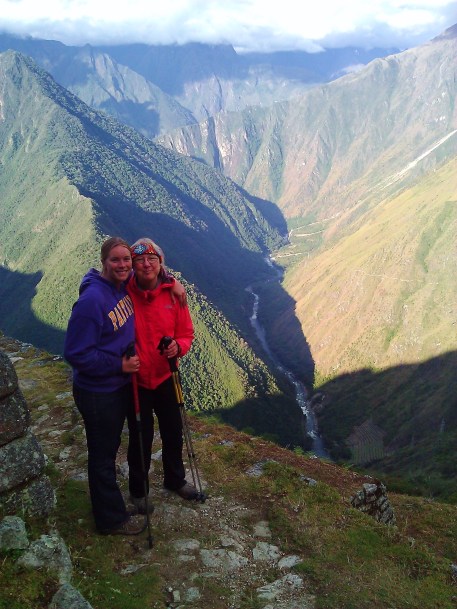
There was only one more day of our Peruvian adventure that was going to end up at Machu Picchu. Day three was over and there was a strong sense of accomplishment in the air. My mother’s sense of pride was down but she was safe and it gave those Quechuan men a story to bring home to The Sacred Valley.
Day-4 Inca Trail
Day 4 came even earlier than most. Bright and early at 3AM porters were knocking on our tents yelling “Wake up! No Coca Tea today.” The night before we had our last evening party. We learned that the porters were cooking all of our food on an open flame, including the cake they made us with frosting that said, “Congratulations!” After dinner, the porters all came in our tent where we essentially got to meet them for the first time. This was also the part of the trip where we were expected to tip the porters for their hard work. Everyone put in around $40 US dollars and my mother was asked to pay twice as much due to the fact that they had carried her. I felt bad for her because she had not been asked to be carried but rather, let them carry her so she could get done with the day faster. Her pride of making it on the hardest day up the mountain had already been erased by the fact that she had to be carried down. But now she was being asked to pay for it… literally. I considered it a donation to the families of the Peruvian men and handed her another $40 underneath the table. She quietly shook her head and gave the men an extra $40 a piece. Even though it wasn’t that big of a deal to anyone else I could see the defeated look on my mother’s face after not having “technically” completed her goal. I could already see the Catholic guilt creeping through her when she told her far less active sister she had completed all 4 days hiking in the Andes. Her sister would say something like, “Wow Jane! You are an inspiration!” And my mother would smile and nod with the truth just inches from her lips.
We went to bed around 10pm knowing very well we would need to be up the following day by 3AM. The gates to Machu Picchu opened at 3:30AM and we needed to be ready. Our dear porters were packing everything up that night and so the morning was going to consist of granola bars and cold coffee. 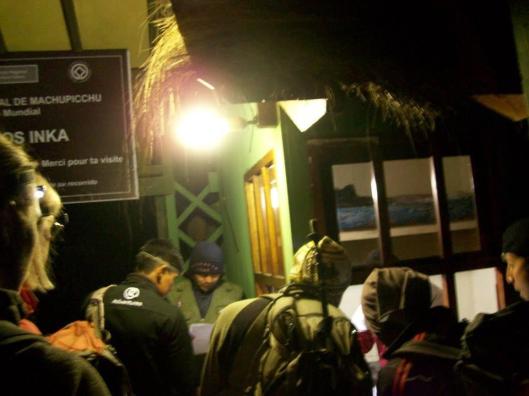
The spot we were hiking to today was officially Machu Picchu. However, unlike most who go see the famous ruins, we were going to hike there rather than take a bus. We still had a grueling 5-mile trek ahead of us. It seemed like my fear of heights was growing with every day rather than going away. I also woke up to a happy surprise. My period 2 weeks early. Like any respectable grown woman, I ran into the tent to tell my mom immediately.
“MOM! I got my period two weeks early what should I do?!” I yelled at her.
“How on earth could this have happened?” I exclaimed further.
“The first step is always denial” she snickered in her post-menopausal state of relief.
“Your body is stressed out,” my mom told me.
“I always got my period after I had surgeries. When your body goes through stress it skips ovulation because it doesn’t want to get pregnant and it goes straight to your period so you won’t. If you keep stressing your body in the same way you will miss your period altogether.”
“I would like to skip to the part where I don’t have my period today please!” I said.
I had known that the three days of hiking had been hard on my body but I didn’t know it had thrown it into full-blown reproductive shock. During my collegiate years, I worked out for 4 hours a day either swimming, lifting weights, and running. Never before had my body shut down into this “emergency period mode.” It was not something I even wanted to happen again.
Considering the toilets, we had on the trail consisted two inches of water surrounding a 6-inch hole in the ground I really didn’t have a lot of options. I went to the restroom, wiped up as best as I could, shoved some toilet paper in my underwear, pulled down the “flush” cable which just sprayed water all over the bathroom to add to the tragedy they called a restroom. I was screwed! So, I did the unthinkable. I walked up to the two Canadians girls that seemed to be prepared for all emergencies and non-emergencies and I asked them for a tampon. They graciously reached into their pack and gave me the smallest tampon I have ever seen in my life. I wasn’t even aware they made tampons that small, they honestly might as well have given me a Q-tip. Needless to say, I was grateful to them for helping me during my time of need and asked them for another. Perhaps I could double them up if that is what the day called for. Was it safe to double up tampons in a murky restroom with stagnant water? Probably not. I told my mother and she relished in their act of kindness and didn’t make any more remarks about what obnoxious things the girls were doing for the rest of the trip. I took their little Q-tips to the bathroom and almost lost it on multiple occasions while trying to put it in. I tried not to think anymore about my tiny tampon and walked out, down the trail, to get in line to wait for the gait to open to begin heading to Machu Picchu.
It was still very dark outside and I looked up to find my favorite star constellation “The Big Dipper.” Sadly, it wasn’t anywhere to be seen. For that matter, none of the stars looked familiar. Paul passed around a star map and reminded us that we were on a different side of the earth. I hadn’t really felt homesick until I looked up at a bunch of stars that meant nothing to me. At home whenever I would be doing something wonderfully fun at night I would look up at the big dipper and smile. I figure after a while all of those smiles would add up into some sort of a time capsule that the stars would hold for me during my favorite moments. I’m having my stupid period anyway, what do I care if this isn’t in my time capsule of memories? I begrudgingly thought as a tilted my head down from the sky. My mother was waiting patiently for the gates to open with a literal smile on her face while she waited.
“A girl from Ohio died on this particular trail just a month earlier,” Paul told us in a serious tone with a hint of a grin. “Right as the gate opened she raced to be the first one to Machu Picchu at 3:30 in the morning. In the dark light and the poorly protected trail, she simply ran right off into the abyss.” I have no idea why he loved telling us death stories so frequently. But next to a love of plants and their medicinal value, it was probably Paul’s favorite thing. There was a trail etiquette the entire way which I was having a harder time following by the minute. It was expected that if two groups of hikers meet another on the narrow trails, the groups of hikers that are closest to the mountain should stop, say “mountainside” press their bodies up against the mountain, and allow the other group going in the opposite direction to go by them on the trail edging the cliff. Not being on the mountainside was the worst and forced me to get far closer to the edge of the trail toward certain death than I wanted to be. Therefore, any time I would meet up with a group of hikers who were on the mountainside. I would cross over to their side of the trail and yell, “mountainside!” and press my body against the mountain as tightly as I could so the other group of hikers would have to go around me on their side of the trail. Hell, if I am going to end up like that Ohio girl I thought. People don’t even know that difference between Iowa and Ohio if I die they’re just going to think it was the other girl anyway. Four miles later we were almost there. Paul informed us that the Incas had made this part of the trail grueling on purpose. In reality, there was a very short route but they wanted to feel exhausted as they ascended toward the lookout, so when they saw Machu Picchu it truly looked like heaven on earth. We got to a stone staircase that had steps that were only 5-inches long. The steps were made of smooth shale instead of granite or limestone which the rest of the trail had been made out of. I was certain I was going to fall and slide all the way back down the shale steps. Like Sisyphus before me, this is how I was going to spend the rest of my eternity. Carefully getting to the top, sliding back down, just to repeat the exact same fate. To my surprise, I made it to the top, walked a few feet, turned left underneath a big arch, and saw a large opening to the mountains full of clouds and fog. I stopped to get a drink while loads of other groups walked passed me. I waited for the rest of our group to catch up with us all of us sat impatiently and waited for Paul’s next direction. He had told us not to go any further but it was clear Machu Picchu was soon to be filling up with many tourists. The buses were going to be unloading soon with all sorts of different characters and I wanted to get there before them. Paul and my mother finally caught up with us and Paul told us to stay put. All we were looking at were foggy clouds, we couldn’t even see Machu Picchu from where we were. Paul said this was all part of the Inca’s plan and around 7:10AM we would see why. Just as the last group of people had passed us to rush to Machu Picchu as fast as possible we saw what Paul was talking about. The sunlight directed itself perfectly at the Machu Picchu ruins clearing the clouds only where the famous ruins stood.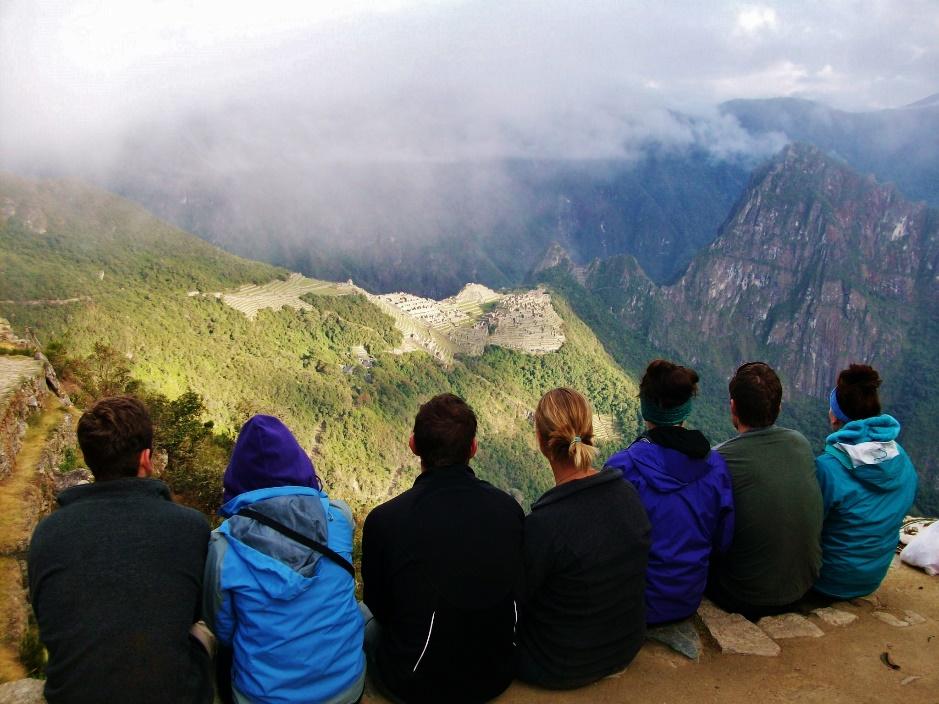
We were the only ones there at the lookout since all of the other groups had left because they were too impatient and wanted to beat the crowds. We sat there as a group as the sun illuminated Machu Picchu like a flashlight would cut through the dark. Paul told us that he often takes Geologists with him on his tours that inform him of odd rock formations that would not have occurred naturally, only manipulated by man. So, this was a matter of guessing, did the Incas choose Machu Picchu’s location based on where the morning light hit first? Or did they manipulate the mountains to shine on Machu Picchu first? Either way, it was breathtaking.
After we had gotten enough pictures we continued to head down the trail to Machu Picchu. Paul would tell us to slow way down and be very quiet in certain parts because we were supposed to “feel the spirits.” I tried my hardest to do this but failed miserably every time. My mother hated that I didn’t have one ounce of spirituality inside of me. She would at least try and humor Paul by saying she felt spirits. By this point, I really just wanted to make it to Machu Picchu.
Finally, we made it! And just as we expected it was packed with tourists. We saw an overweight person for the first time in 4 days and it was odd seeing all of these people dressed in different clothes. All of the porters had left and I honestly kind of missed them. I think about them and what they are doing often. Are they with their families or are they hiking peoples crap up and down the mountains of Peru? Paul continued showing us around Machu Picchu. Every single thing we saw was in some way “sacred” to the Incan people.
“Come into this room” Paul would say. As you can see there are 7 windows. The number 7 was very sacred to the Incan people.”
“He just said that about the numbers 1,2,5,6, and 8 too I said to my mom.” She chuckled like a school girl afraid she was going to get into trouble with the teacher.
Later we got to a place where you could pet alpacas (for a small fee of course). Paul informed us not to feed the alpacas. Without skipping a beat, the second Paul looked away one of the Canadian girls slipped the alpaca some food from her bag.
“Can we go back to not liking them?” I whispered to my mom.
“Yes,” she replied with a soft laugh.
We continued walking around hearing about how everything was sacred for a different reason even though there wouldn’t be any way of knowing what was sacred to them or not. Sometimes you just put four windows in a room because four windows look nice there. As the heat throughout the day progressed we grew tired of Machu Picchu. Honestly, Machu Picchu itself had been one of the worst parts of the trip. It was crowded, stuffy, and not much more impressive than anything else we had seen on the hike that had a quarter of the people. Not to say it wasn’t impressive, but we had just spent 4 days hiking on a trail that which was cut and drug to a proper location by a human 2,000 years ago. And that trail extended all the way from Bolivia to Columbia. Anything that happened on this day that was great, was only because Paul had made it great with his expertise. We decided to grab our gear and hop on a bus to the main road. We had dinner in a café even though we’re all just about out of money after the unexpected porter pay. With our new excitement, we quickly forgot the number one rule of Peru which is of course:
Do not eat anything that isn’t cooked, and drink bottled water only. We ate victoriously to celebrate our accomplishments. And the following day we had diarrhea victoriously and paid sincerely for our lapse in judgment. This was easily the worst diarrhea I have ever had in my life. Between that, and the fact that my body was violently making sure it wasn’t going to get pregnant, the restroom looked like a crime scene every time I visited it. This ended up being about every 5 minutes. Since I wasn’t eating I had no idea where it was coming from as it poured out of me like a gusher. If my mother wasn’t on the toilet I was. And between that and my period, I honestly thought about adult diapers.
“What sizes of adult diapers are there mom?” I asked once when she was coming out of the restroom.
“You don’t need adult diapers, Jean, you’ll get better I promise.” The next day I was still in and out of the bathroom but my mom decided to suck it up and headed on a tour of the salt mines. I had no idea how she contained herself on a bus that traveled quickly on uneven roads but she was determined to see as much of Peru as humanly possible. Be damned if she was going to let some explosive diarrhea get in the way of that.
I however watched dubbed crime shows on television and took naps all day while eating new and exciting random foods from the carts on the street. I purchased these foods during my 15-minute intervals of diarrhea. After All, thanks to the concept of double jeopardy, which was also a movie I got to watch in Spanish, I couldn’t get diarrhea again while I was currently having diarrhea. Or so I thought.

 Traveling Amazon